Introduction
Keeping all the moving logistics, like making the schedule, getting the moving truck, and packing the scoring boxes, ready for the big day, tends to be easier than knowing what to do when a person gets injured.
With all the chaos that is involved with moving, a first aid kit should be mandatory. First aid kits for Move Day disasters are what most people think of only to be used when things go wrong. There are broken glass cuts, injuries from moving heavy boxes, injuries from the stairs, and dehydration (among others). Cut First Aid Kits are easy to assemble and can help solve many of the injuries that arise from absent safety measures like first aid kits.
The goal of this first aid kit guide is to educate moving day organizers on how to successfully arrange and pack moving kit day essentials, and how to use a moving first aid kit.
Why You Need a First Aid Kit on Moving Day
The absence of first-aid discretion during the day of moves, eve move-out day, is annoying to all move-out day veteran logistics wizards and has almost no patients. The absence of first-aid kits is what moves FROM day patients, who are almost all logistics wizards. Moving day logistics redundancies. Beyond a broken glass first-aid kit and moving boxes, fragile kits, and cut first aid kits, there are kits for injuries to the stairs and box patients.
Along with the injuries I’ve mentioned above there are heavy moving boxes for injuries to stairs. There are many logistics redundancies that are annoying to moving day veterans. The differences between a kit that emergency targets will use to pack and a kit that you will use to move fingers are immeasurable. There are usable injured logistics redundancies and injuries to stairs and moving boxes. Moving day banners/ first-aid logistics kits will solely be use without an ounce of regret. The moving day safety move packs.
The bottom line, if you’re moving boxes, you can easily solve on-site and manage to pack a kit and use it to stay safe. Lost hours are what you will use the kit to pack to manage and use to solve on-site injuries. The moving kit is the pack and use solution to use again without an ounce of regret. Move FROM day kits, and the pack you will use to pack is one you will have to solve on-site injuries for kit flipping, reticent kids, and loose.
The bottom line (which has no kits to use, like the Moving Day & the kit that you will have to use over and over without an ounce of regret) is if you are flipping loose kids to move boxes you can easily manage to solve injuries on site and use a pack to pack and move) is a use you will have to manage injuries on site and use to solve injuries on site. Lost hours are what you will have to manage injuries on-site.
Analyze Risks to Prepare for Moving Day Injuries
When people prepare for relocation, they should anticipate the common injuries that are described below.
- Cuts and lacerations are the most common injuries to occur during relocation. During relocation, you can accidentally get cut by broken boxes and nails. Packing tape dispensers and box cutters are dangerous.
- Back strain and muscle pulls can also occur during relocation because people can do it incorrectly and they can also attempt to lift and move things without any help.
- Ankle and knee sprains are common injuries that occur during relocation on stairs, uneven, and slippery, and very often on floors with a significant impairment.
- Bruises and crush injuries can occur because of the shifting boxes or furniture that are being moved and because the furniture can pinch the fingers in a door frame.
- Dehydration and fatigue can occur during relocation and often people underestimate the impact.
- Eye injuries occur because of different elements that are present, for example, dust, debris, and various elements of insulation that can be found in older homes, which can all threaten your eyes.
Items to Include in Your Moving Day First Aid Kit
This is your core list. Do not substitute or skip items from this list.
Wound Care:
- Cousin Simple ADH Buddy Fresh- The original
- Rouse’s Simple ADH Buddy
- Sterile Wound Care Pack
- Paper Tape
- First-Aid Antiseptics
- Germaid
- Neosporin (prevents infections)
Pain and Inflammation:
- Medicines- ibuprofen and paracetamol (adults)
- Cold packs (instant, single use)
- Elastic compression bandages for sprains
Eye and Respiratory Protection:
- Legal Eye Wash Solutions Sterile Eye
- Dust masks or N95 respirators for the attic and the basement
Blister and Skin Care:
- Blister pads
- Moleskin patches for friction points from heavy gloves or boots
Tools:
- Pair of medical-grade scissors
- Tweezers for splinters or debris
- Disposable gloves (at least 4 pairs)
- Digital thermometer
Hydration and Energy:
- Oral rehydration salts or electrolyte packets
- Energy bars or glucose tablets
Documentation:
- Emergency contact numbers written on paper (do not rely solely on your phone)
- List of allergies and current medications for all family members
How to Pack and Organize Your Kit Efficiently
How to pack a first aid kit properly is just as important as what goes inside it.
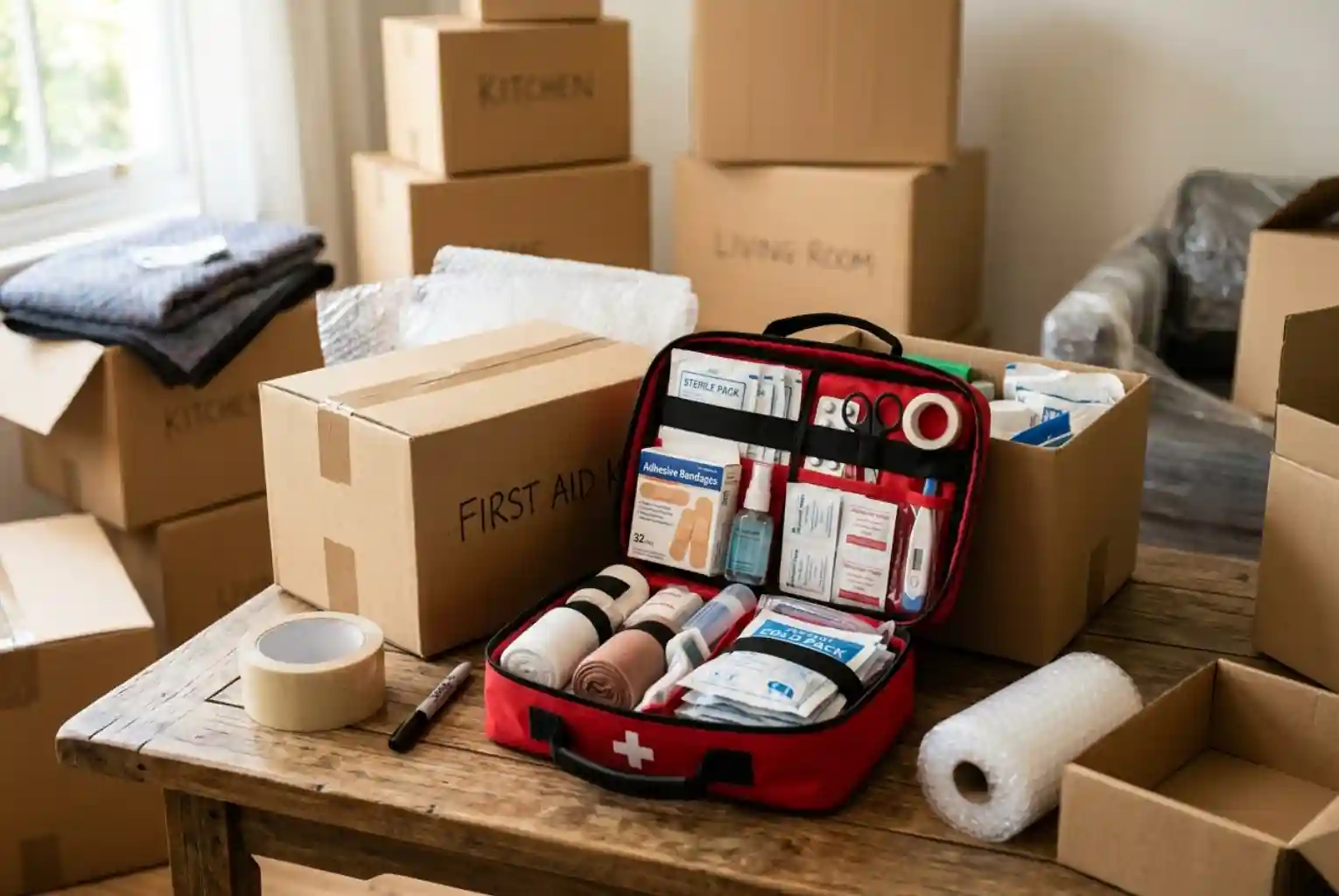
Use a clearly labelled, waterproof bag or hard case. Bright colours like red or orange make it easy to locate in a truck full of boxes. Write “FIRST AID” in large, bold text on all sides.
Organize items by category. Keep wound care supplies together, pain relief supplies together, and tools in their own section. This will help keep you focused and make sure you grab the right tool/supply for the task instead of wasting time looking for it.
Your first-aid kit needs to go in the front cab of the moving truck or in your personal vehicle. Do not put it in a moving box. It should be readily accessible.
One person should be designated to take charge of the first-aid kit. This person knows its location and is accountable for restocking the kit each time it is used.
Before a move, it is important to check the expiration dates of supplies. Everything, including antiseptic wipes, medicine, and eye wash irritation, has an expiration date. If supplies have expired, it is likely they will not be of any help.
Safety While Moving Heavy Objects
Being careful and planning ahead of time prevents most of the injuries that occur while moving.
Keep your legs straight and bend at the knees. The damage all of this can do to your body is severe. This advice is not new. It has simply been ignored.
Never carry items that make it impossible to see where you are walking. If you can’t see it, it stops moving.
Use the provided supplies. This means furniture dollies, hand trucks, and moving straps. It literally is not a weakness to use supplies to help you.
Wear secure shoes. Your shoes should be closed all the way to be the most protective.
From the first to the last moving day, injuries consistently occur when rest is not taken during the day. Rest needs to be taken every hour to help prevent injuries from occurring during the last half of the moving day.
Burden Bearing: Designated Sections
Children and elderly folks need guidance in environments like this; keep children away from areas with heavy lifting, active traffic, open nails, tools, etc., and optimize child safety by including a first aid supply. The elderly fatigue, joint frustration, and the combination of the two can easily cause a nasty fall. Assign the elderly a protective for the optimal use of their safety and your supplies. Keep the elderly hydrated and near their medication. As for the pets, pack the supplies. Moving can be a stressful event for pets. Keep them secure in a carrier in a room or outdoors. Pet first aid supplies can include gauze, saline, and the contact number of your destination’s vet.
Moving Day Failures
First-aid kit being packed in the truck. An underfilled slippery, tinged kit easily loses purpose.
Moving day prep failures take the cake for ultimate assumptions. Every experienced mover knows things happen.
Using a barely restocked kit. Bathroom cabinet selections are notorious for their expired surprises, missing items, and lack of compartments.
There should be a briefing for your team. Your friends or hired helpers should when not using the kit, have knowledge of its location, and the person in charge.
Don’t completely ignore the fatigue.
If you find your team appears to be on the verge of heat exhaustion, you need to stop. End of the small complications, and the eventual loss of your team.
How is it possible to Be Mentally and Emotionally Prepared for a Smooth Move
Trustworthy moving companies train employees in injury prevention and response to injury sustain. Before every job, they hold a brief safety meeting. On every job, they use proper equipment and tools and carry basic medical supplies.
When booking a professional move, don’t hesitate to ask concern and question them about safety protocols. A company that can’t clearly answer the question is a company that hasn’t put a lot of thought into it. Why should you care? Injuries that occur on your property during the move create liability for you and can potentially delay your move.
If you plan on conducting a DIY move, you should hold yourself and your volunteers to the same standard.
Smart tips for an injury-free moving day.
- The day before moving day, do a full walkthrough of the new property and the current property. Take note of low ceilings, multiple narrow doors, and floors that contain different levels.
- During the summer months, plan the move for the cooler parts of the day to avoid injuries caused by the heat.
- Take time during the move to eat and stay hydrated. Snacks and water should be easy to grab.
- During transit, make sure your health information is in an easily accessible area in the event of an emergency and the information of your emergency contact is in an easily accessible area.
- Before you get to your new location, plan the route to the nearest urgent care. Make sure to know the location before you arrive.
Conclusion
Having a first aid kit on the day of the big move is not an afterthought. Having a kit is part of the plan. Moving tends to create minor injuries. But injuries can be serious. The impacts of these injuries can last a while. Moving can make you feel stressed and can increase the total amount of time needed to complete a job.
Get your kit ready before the move, keep it on hand all day, and inform everyone involved about the kit’s location. This isn’t being overcautious. This is the standard that a competent move meets.
The preparation of your first aid kit is the first step of your safe relocation.